I recently created a 'My workouts' page listing all of the exercises that I do during the week. The more observant of you will notice that I've split my weight training into 3 categories; Chest + Back, Arms + Shoulders and Legs.
This Post will go into more detail on what I do with these workouts. Its always important to change your workouts, as after a while your body learns how to do exercises more efficiently resulting in a poorer workout. I'm not going to go into what I do for my abdominal exercises as this can change on the day depending on what I fancy, though if you look through my post on Abs you can get a good flavour on the kind of things I like!
Showing posts with label Muscles. Show all posts
Showing posts with label Muscles. Show all posts
Wednesday, 28 November 2012

Friday, 23 November 2012
Muscle Groups - The Chest (Pectorals) Part 1
Muscle Groups - The Chest (Pectorals) Part 1
My last muscle groups post was about the abdominal region of the body, so it makes sense that the next thing I discuss lies next to this; The Pectoral Muscles. The Pecs are to the chest what the Abs are to the stomach, If you want to look like you in good shape and fairly strong you need to have good Pectoral Muscles. Like last time Part 1 will concentrate on the Anatomy and how you can stretch these muscles prior to a workout and part 2 will go into more detail over the exercises you can do!The Anatomy:
The pectorals are slightly less complex in structure then the abdominals in the fact that they are only split into 2 main regions:
 |
| Pectoralis Major and Minor |
Friday, 16 November 2012
How the Body makes Energy
As you should be aware, in order to exercise (or just do anything in general) our body needs energy. The big question really is how do we get this energy and what is it produced from? Well if you read my earlier post on A Guide to Nutrients then you would know that we get our energy from carbohydrates, protein and fat, but not in equal measures (carbs and protein produce 4kcal/g where as fat produces 9kcal/g respectively). This is not the full story though, usable energy is created using a molecule called ATP (adenosine triphosphate), but all of these nutrients are involved in different ways to produce this chemical. It is probably worth pointing out that this post is going to be a precursor to one on weight loss through exercise and also another article about pre exercise nutrition! This post is a bit heavy with biology and chemistry but it isn't too complex so don't panic!
The amount of energy released is about 7.3kcal/mol (1 mol is equal to 6x10²³ units of a compound) which is a relatively small amount however as the ADP unit can be regenerated back into ATP by using the nutrients in our food, we can keep repeating this reaction, so long as we have energy with which to do the reverse reaction! An interesting fact about ATP is that we have so little of it in our body, on average we only have about 250g, which when you compare the size of us and the amount of energy we have, is only a very small amount.
So what is ATP?
ATP is thought of as the energy currency of the body, its used in virtually every process in the body. It is made up of adenosine (an adenine ring and a ribose sugar) and 3 phosphate groups. ATP produces energy by hydrolysing (reacting with water) one of the phosphate groups to form ADP (adenosine diphosphate) and a cleaved phosphate group, releasing energy in the process.
ATP + H2O → ADP + Pi
The amount of energy released is about 7.3kcal/mol (1 mol is equal to 6x10²³ units of a compound) which is a relatively small amount however as the ADP unit can be regenerated back into ATP by using the nutrients in our food, we can keep repeating this reaction, so long as we have energy with which to do the reverse reaction! An interesting fact about ATP is that we have so little of it in our body, on average we only have about 250g, which when you compare the size of us and the amount of energy we have, is only a very small amount.
 |
| Adenosine ring (right) with the triphosphate tail (left) |
The Energy systems
- The Phosphagen System
- The Glycogen-Lactic Acid system ( or anaerobic glycolyic system)
- The Aerobic system
All of these systems are used in tandem when ever you exert any effort on a task, they are also all important in their own rights as the exert energy at different rates and at different energy levels!
The Phosphagen system
This system uses phosphocreatine to generate ATP to be used in the body. In every muscle you will automatically have a small amount of ATP, this is used up very quickly and needs to be replaced if any more work is to be done. The Phosphagen system is used to quickly replace this ATP by breaking up phosphocreatine using an enzyme called creatine kinase into creatine and a phosphate group plus a bit of energy. The energy is then used to bind the phosphate group to an ADP molecule thus regenerating the ATP molecule needed for energy transport.
Phosphocreatine → P + Creatine + Energy
ADP + P + Energy → ATP
This process is very rapid and can generate ATP instantly to be used in explosive movements, such as when trying to lift a heavy weight or when sprinting. There is only a small amount of Phosphocreatine available so after 6 seconds or so this system ends and cannot be used again until the creatine is converted back to phosphocreatine which takes time. It is unsurprising then that we can only sprint at full pace for a few seconds as the energy produced cannot match the energy required!
Many of you will have heard of people taking Creatine supplements and this is the reason why. If you can raise the amount of creatine in your body you theoretically should have more explosive energy and should be able to lift heavier weights for prolonged periods, this however is something I plan to discus in a post about supplements in the future! For the sake of this post though its worth saying that creatine is made naturally within the body using amino acids that are obtained from protein in the diet!
The Glycogen-Lactic Acid system
This second system is a longer lasting but a bit less rapid system then the first method and involves the anaerobic breakdown of glucose. As mentioned in the post about nutrients, Carbohydrates are broken down and converted to glycogen for storage. When we need energy they are converted back into glucose and used as a fuel to make ATP. This can be done in 2 different ways, 1 of them using oxygen (aerobic system) and the other without oxygen (anaerobic system). This system focuses on the second one and is important when considering high intensity activity that last for about 1-2 minutes.
When glucose is broken down as a fuel source when there is no oxygen present it gets converted into pyruvic acid and then to Lactic acid, while at the same time producing 2 molecules of ATP. This process is dependent on 2 things, the amount of glucose available, which is obviously limited, and the amount of Lactic acid produced. Lactic acid is a chemical that is linked with fatigue, and causes the burning sensation you feel when you've done some high intensity workouts. It isn't actually the Lactic Acid that causes this burning sensation but the Hydrogen Ions that are produced with it. Either way if the build up is too large then it will cause muscle damage and stop them from contracting. This means that we can only use this system for a short amount of time, which is why it only really dominates in high paced distances such as 400 / 800 meter running or when doing a set of weights in the gym.
 |
| Aerobic Pathways (left) and Anaerobic Pathways (right) |
If using the anaerobic route only lasts a short amount of time, produces a short amount of energy and also causes harm to our body, they why do we do it? The simple answer is the speed at which it occurs, while not as fast as the Phosphagen system, it is still much quicker then the aerobic system so will help us get energy straight away and get the body moving, this would have been essential to our survival when we first walked this earth as if it took a couple of minutes before we had the energy to run away or fight something we wouldn't have survived as a species!
The Aerobic System
The final system produces by far the most energy but is also by far the slowest method by which ATP is regenerated! It is similar to the anaerobic method in the fact that it converts glycogen to glucose but this time oxygen is present so a different reaction pathway is followed!
The glucose is again converted to pyruvic acid creating 2 units of ATP but this time it doesn't get turned into lactic acid. Instead the pyruvic acid is used in the pathway called the Krebs cycle which is done in the mitochondria within the cell (they are like the batteries of the cell!) and produce another 36 molecules of ATP brining the total up to 38 units of ATP! As you can see this is a massive increase compared to what was available before! On top of this fat can also be used to make ATP using oxygen and this produces between 80 and 200 units of ATP, it isn't surprising that fat makes more as I mentioned before that it is far more energy rich!
This process is clearly far more energy rich, with the only major downside being the rate at which it occurs. The question is; why does it take so long to produce energy? There are 2 reasons for this, the first is that large amounts of oxygen is required, which means that the rate at which you breath needs to be increased, which relatively is a slow process, on top of this the reaction pathway is very long so it takes long for the ATP to actually be made!
As you may have already guessed, this system is more suited for long term 'endurance' events like long distance running or any even that takes an hour or longer. This gives us a clue as to why you will burn off more fat by jogging then by sprinting. Fat can only be burned off through aerobic activities, and as the concentration of glucose in the muscle and blood decreases the amount of fat used for energy increase. It is important to note however that fat needs carbohydrates to be used as fuel, so don't think that you can just cut out all of your carbs and your will just burn through your fat, this just won't happen!
 |
| Photo borrowed from Howstuffworks.com |
That's your lot on energy systems for now, Sorry for all the text I promise the next post will contain more pictures!! If you need any more detail on anything said above let me know!
Cheers,
Rich
References
Monday, 5 November 2012
Muscle Groups - The Abdoninals Part 2
Hello!
So in the first part of this I showed you what makes up your abs and how you can stretch them. In this second part I'm going to move onto some exercises you can do to help work these muscles, as well some advice to help you show them off better!
Before I get into the actual exercises it is important to look at how much you should be doing. It is generally agreed that you shouldn't do too much work on your abs. By no means should you ignore them but realistically you only need to spend 5 to 10 minutes of a training session working them, this may surprise you considering the fact that there are hundreds of different exercises that you can do to work them. If you have ever done an abs class at the gym you may find that they tend to mix them in with workouts for other parts of the body, this makes sense because if you have ever done 5 minutes of intense core workout you know your going to struggle to do much more.
I'd also like to bust a couple of myths here while I can, you will not burn off stomach fat by doing lots of crunches. It is impossible to target one area of the body for fat loss, and unfortunately the last part of your body to loose fat, so to get results you need to combine this exercise with others (including cardio) and a balanced diet. Another myth is that once you have got your results you can stop working. Even with a muscle regularly used like you abdominals, regular exercise is needed to maintain them, with attention needed on keeping your body fat low!
That's all of the exercises for now, though I may post some more difficult ones at a later date. Just remember what I said before, don't spend too much time on these exercises and mix them with other workouts for the best results. If you've got any thoughts leave me a comment!
So in the first part of this I showed you what makes up your abs and how you can stretch them. In this second part I'm going to move onto some exercises you can do to help work these muscles, as well some advice to help you show them off better!
Before I get into the actual exercises it is important to look at how much you should be doing. It is generally agreed that you shouldn't do too much work on your abs. By no means should you ignore them but realistically you only need to spend 5 to 10 minutes of a training session working them, this may surprise you considering the fact that there are hundreds of different exercises that you can do to work them. If you have ever done an abs class at the gym you may find that they tend to mix them in with workouts for other parts of the body, this makes sense because if you have ever done 5 minutes of intense core workout you know your going to struggle to do much more.
I'd also like to bust a couple of myths here while I can, you will not burn off stomach fat by doing lots of crunches. It is impossible to target one area of the body for fat loss, and unfortunately the last part of your body to loose fat, so to get results you need to combine this exercise with others (including cardio) and a balanced diet. Another myth is that once you have got your results you can stop working. Even with a muscle regularly used like you abdominals, regular exercise is needed to maintain them, with attention needed on keeping your body fat low!
Exercises
I'll be splitting the exercises into 4 different groups, Upper abs, Lower abs, (these focus on the rectus abdominis), the obliques (both internal and external) and transverse abdomini.
Exercise 1 - Traditional Crunch (Upper abs)
This is the most well known exercise for working the abs, while not quite the standard sit up it is very similar. The starting position is to lie down with the knees bent, you can use some weights or a bar to hold your feet in position if necessary.
Next you need to lift your shoulder blades off the floor in a crunching motion, you don't need to reach your knees like in a sit up. To increase the difficulty you can hold a dumbbell plate against your chest for extra resistance.
Now you need to lift your legs to your chest and hold it, then lower them back to the starting position. It is important not to let your body swing and to use your body not your moment to lift your legs up.
 |
| Starting Position |
 |
| Finishing Position |
Exercise 2 - Hanging knee raise (lower abs)
Lower body movement is needed to work the bottom of the abs, as the name suggests you need to hang from a pull up bar for this exercise with your hands at shoulder length apart and arms straight.
 |
| Starting Position |
 |
| Finishing Position |
Exercise 3 - Side Jackknife (obliques)
The starting position for this exercise is similar to the side plank but with your waist on the floor. Another words you need to lie on your side leaning on your arm.
 |
| Starting Position |
Now without moving anything else raise your legs off the floor a couple of inches, hold at the top and lower, now swap sides and repeat. You can either have you hand against your side or behind your head for some additional difficulty.
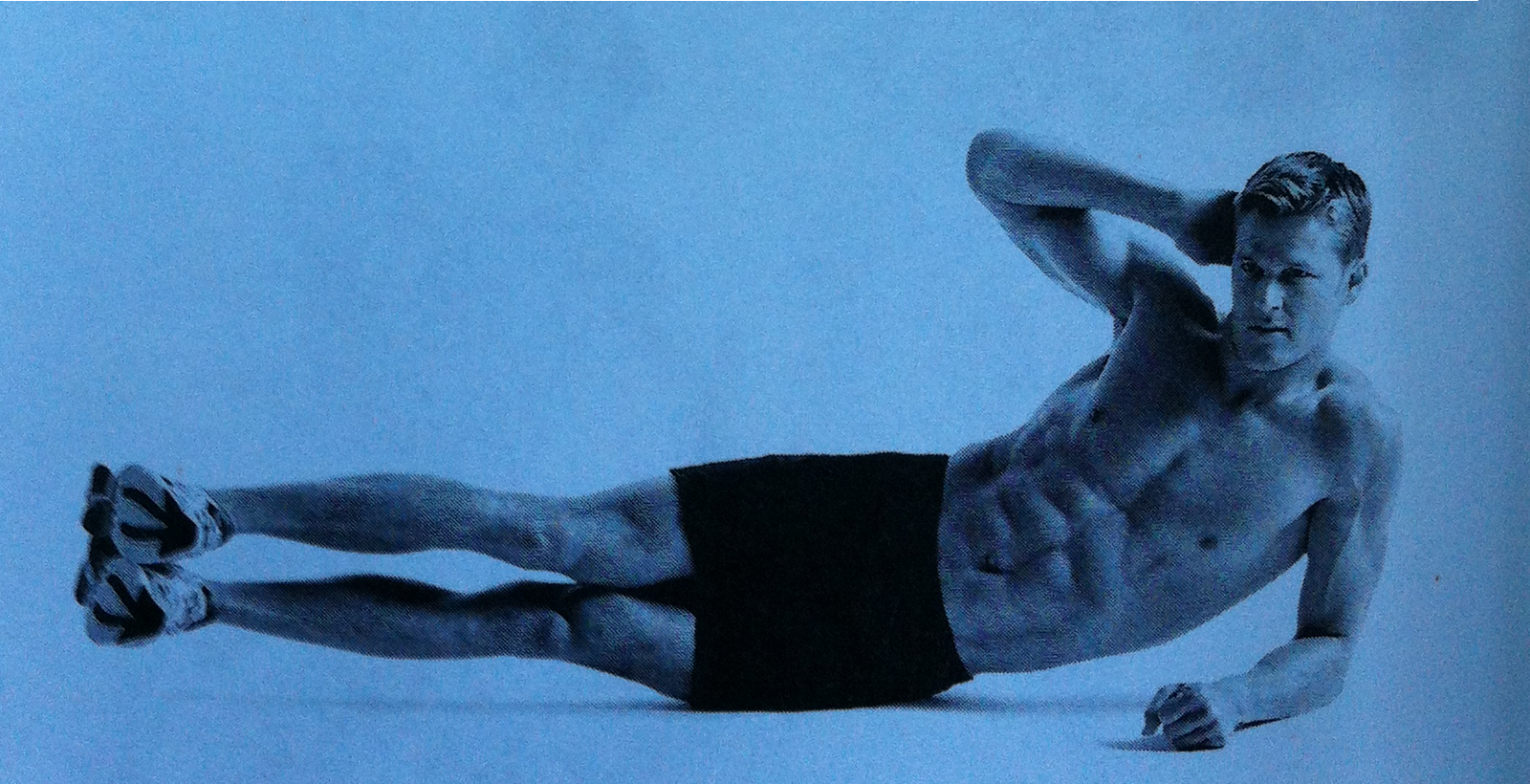 |
| Finishing Position |
Exercise 4 - Plank (Transverse Abdomini)
This is another one of the well known exercises for your core, it's simple but incredibly effective which is why its so well known. To perform the plank just assume a press up like position, but with your forearms on the floor. Keep your back straight and tense your stomach, now hold this position for between 30 - 60 seconds. While it may sound easy by the end of 60 seconds (provided you've kept your shape) then it should be very difficult, to make this harder you can increase the time or have your legs on a platform.
 |
| Position mid-plank |
Cheers,
Rich
References:
iMuscle App for iPhone and iPad
The new abs diet - David Zinczenko
iMuscle App for iPhone and iPad
The new abs diet - David Zinczenko
Sunday, 14 October 2012
Muscle Groups - The Abdoninals Part 1
It seems like the best place to start when talking about muscle exercises is the Abdominal muscles, having good abs is the sign of someone who is at the top of their fitness and rightly so as it requires a lot of hard work to get these muscles into top condition. There is a lot to talk about with looking after your muscles so I'll be breaking this into two parts. Part 1 will give you an insight into what makes your abs and how to stretch them, with part 2 looking into the equipment you can use and how to exercise them! So lets start with a brief biology lesson:

Now twist your torso in the opposite direction to the crossed leg until you can feel the stretch and hold it for about 20 seconds then change legs and repeat
The Anatomy:

Picture from wiki commons
- Rectus Abdominis - This is the muscle that defines the abs, it is responsible for the '6 pack' that so many people crave. It consists of 2 vertical muscles that run from the pubis up to the 5th rib covering all of the abdomen. It has various functions that include helping with posture as well as helping to flex the spine in a 'crunch' motion. It can also play a part in forceful respiration such as heavy breathing after intense exercise and helps to protect the organs behind it.
- External Obliques - These muscles run across the side of your midriff and are involved in any rotation that the torso does, so when you turn from side to side or go to throw a punch for example these are the muscles that allow your rotation to occur, they also allow sideways bending of the torso.
- Internal Obliques - These unsurprisingly are found beneath the external obliques and they also are at right angles to the external obliques. They are similar to the external obliques in that they are also involved in the rotation of the torso, however they run in an opposite direction, for example; if the left internal oblique contracts and so does the right external oblique contract then this will bring the right shoulder towards the left hip. As well as this the internal obliques are also involved in breathing by helping move the diaphragm up and down.
- Transverse Abdominis - This muscle lies beneath the rectus abdominis and holds your abdominal region together. It is involved in respiration and is used to pull the abdominal wall in, so basically this is the muscle you use when you want to such in your gut and make your belly look smaller then it really is!
Now that you know what makes up your abs its time to look out how you can stretch them out.
The Stretches:
It's important to stretch well before a workout as this will allow you to work to your best, as well as avoid injury. It's wise to do stretch after a work out as well as this will prevent muscle stiffness the next day and will speed up recovery time!
Stretch 1 - Waist Press
This stretch works your rectus abdominis and starts off in a press up position with the body pressed against the ground and with the arms perpendicular to the body with the hands placed against the floor.
Next push your torso up using your hands while keeping your waist close to the ground, once you get to the top of this movement and can feel the stretch, hold this position for about 20 seconds.
Stretch 2 - Hip Stretch
The Hip stretch will help stretch you obliques by doing some simple controlled rotations. start by lying with your back to the floor and with one leg raised and crossed over the other leg.
Now rotate the raised leg in the opposite direction (so move your right leg left or your left leg right) until you feel the stretch and hold this for about 20 seconds. When you've stretched one side, swap legs and do the same for the other leg.
Stretch 1 - Waist Press
This stretch works your rectus abdominis and starts off in a press up position with the body pressed against the ground and with the arms perpendicular to the body with the hands placed against the floor.
 |
| Start position |
 |
| End position |
The Hip stretch will help stretch you obliques by doing some simple controlled rotations. start by lying with your back to the floor and with one leg raised and crossed over the other leg.
 |
| Start Position |
 |
| End Position |
Stretch 3 - Seated twist
This again will help stretch out your obliques but should help stretch your internal obliques more then stretch 2! Sit down on the floor with your legs straight, now cross one leg over the other one (basically the same as the previous stretch but sitting up)
 |
| Start Position |
 |
| End Position |
References:
http://www.fitnessuncovered.co.uk/core-muscles.php
All stretch images are taken from the iMuscle app for iPhone
All stretch images are taken from the iMuscle app for iPhone
Subscribe to:
Posts (Atom)